Building SkyChart Dev Blog #2: Fifteen Versions, One Very Busy Runway
Table of Contents
When we published Dev Blog #1, SkyChart was at v0.2.17 — a functioning airline sim with 150 cities, 33 aircraft, and an engine that mostly kept up. We said we’d be back with more. We did not expect to come back with this much more.
Fifteen versions later, the game has tripled its city count, doubled its fleet, gained full controller support, an accessibility overhaul, economic warfare systems that would make OPEC nervous, and a rendering engine that no longer begs for mercy at 1,600 routes. We’ve been in the hangar for a while. Let’s walk you through what changed.
Casey the studio macaw insists we mention he personally supervised every update. He did not. He ate walnuts and judged us.
The Engine Overhaul Nobody Saw (But Everyone Felt)
Let’s start with the unglamorous stuff that makes everything else possible.
At v0.2.17, zooming out on a big route network was… cinematic, in the worst way. 9 frames per second with 1,600 routes. The map was redrawing every single route, every single frame — 19,000 individual line nodes doing their best impression of a PowerPoint slideshow.
We rebuilt the entire route rendering engine from scratch. One batched draw pass replaced thousands of individual nodes. Panning the map now costs zero draw calls — the rendered image just slides. Routes only redraw when the network actually changes. The result: 60 FPS locked, even with thousands of routes crisscrossing the globe.
We also grounded 56,000 invisible airplane sprites that were still burning CPU every frame like ghost pilots collecting overtime. Hidden planes now get their processing licenses revoked entirely.
Then we built an auto-tuning performance benchmark. Hit “Run Benchmark” in Settings and the game stress-tests your GPU, CPU, and texture pipeline in about 8 seconds, then auto-tunes 11 performance limits to match your hardware. Route display thresholds, tile cache sizes, weather density, recommender thread counts — all calibrated automatically. Push a slider past the recommended zone and you get a yellow warning. We’ve seen captains ignore Casey’s gauges before. It never ends well.
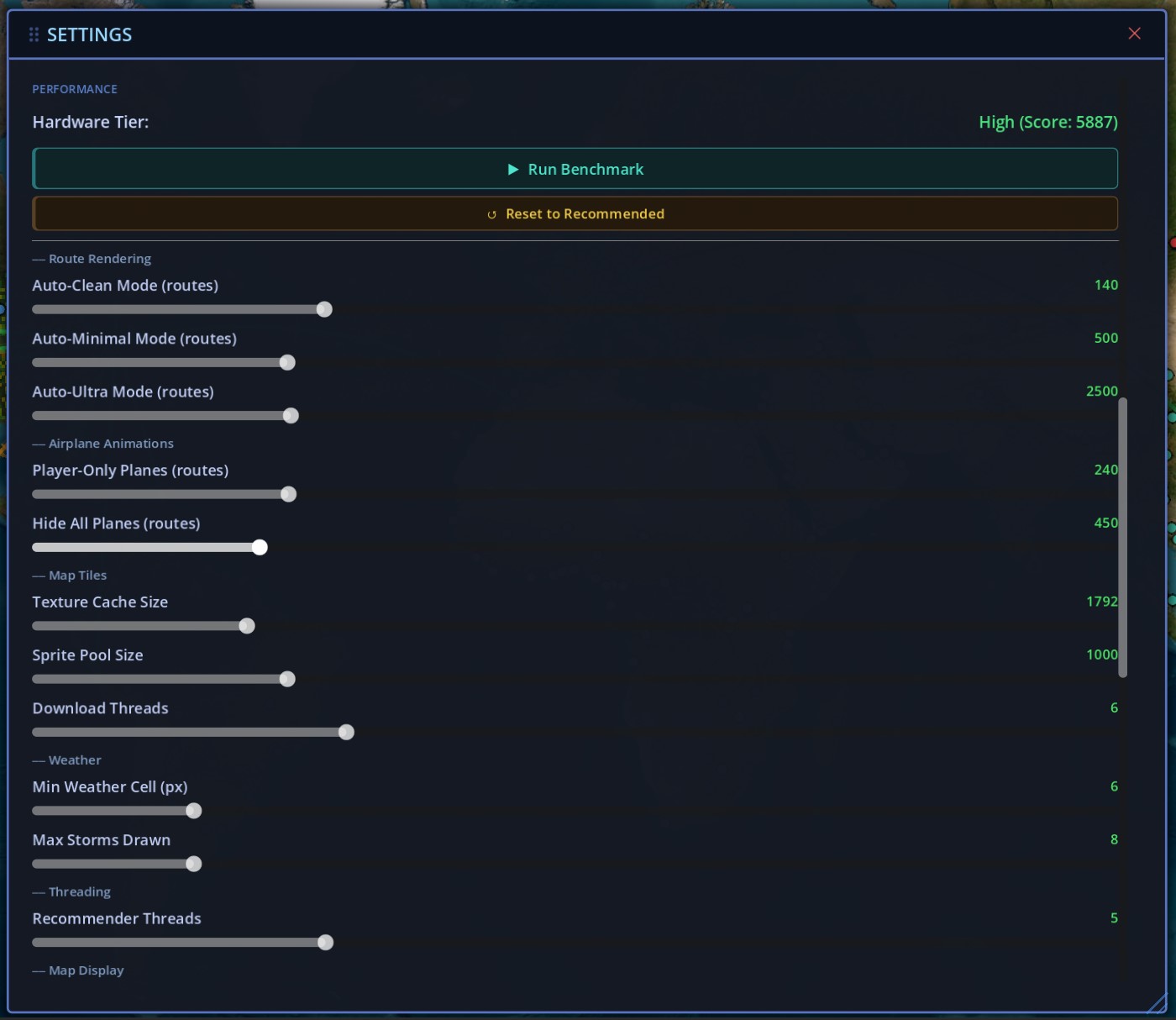 Your airline now has an IT department. The benchmark tunes 11 settings so you don’t have to.
496 Cities. 66 Aircraft. Endless Mode.
The world got a lot bigger.
496 cities are now on the map — up from 150 — spanning Timbuktu to Petropavlovsk-Kamchatsky (we needed three attempts to pronounce it). Every new city has researched 1930 populations, growth rates, economic values, IATA codes, and real airport coordinates. A 4-tier visibility system keeps the map readable: Global Hubs are always visible, Minor cities appear only when you zoom in close.
The fleet doubled too. 66 aircraft now fill the catalog — historically accurate models from the Cortez Condor biplane (1933) through the modern era, plus speculative future designs like the Bering Orbital 1 suborbital transport (2085), extrapolated from real-world concepts and emerging aviation tech. Propellers to hypersonic plasma drives. Save files from older versions auto-migrate seamlessly — no aircraft lost, no paperwork misplaced.
Complete all four eras and you unlock Endless Mode — fly past 2020 with no time limit and no objectives. Hydrogen jets, blended wing bodies, and orbital hoppers await in the decades ahead. The sky isn’t the limit anymore.
And because not everyone wants to play at the same speed, we added four game pace options: Arcade (45 seconds per month, for the impatient), Standard, Extended, and Realtime (30 minutes per month, for captains who savor every turbulence bump). Airplane animations match your chosen pace — Arcade planes zip across the map like Casey after finding an unguarded bowl of walnuts.
The Strategic Advisor from Blog #1 used to crunch 11,175 city pairs. It now crunches 122,000+. On a background thread pool. Without breaking a sweat. We’re genuinely proud of that one.
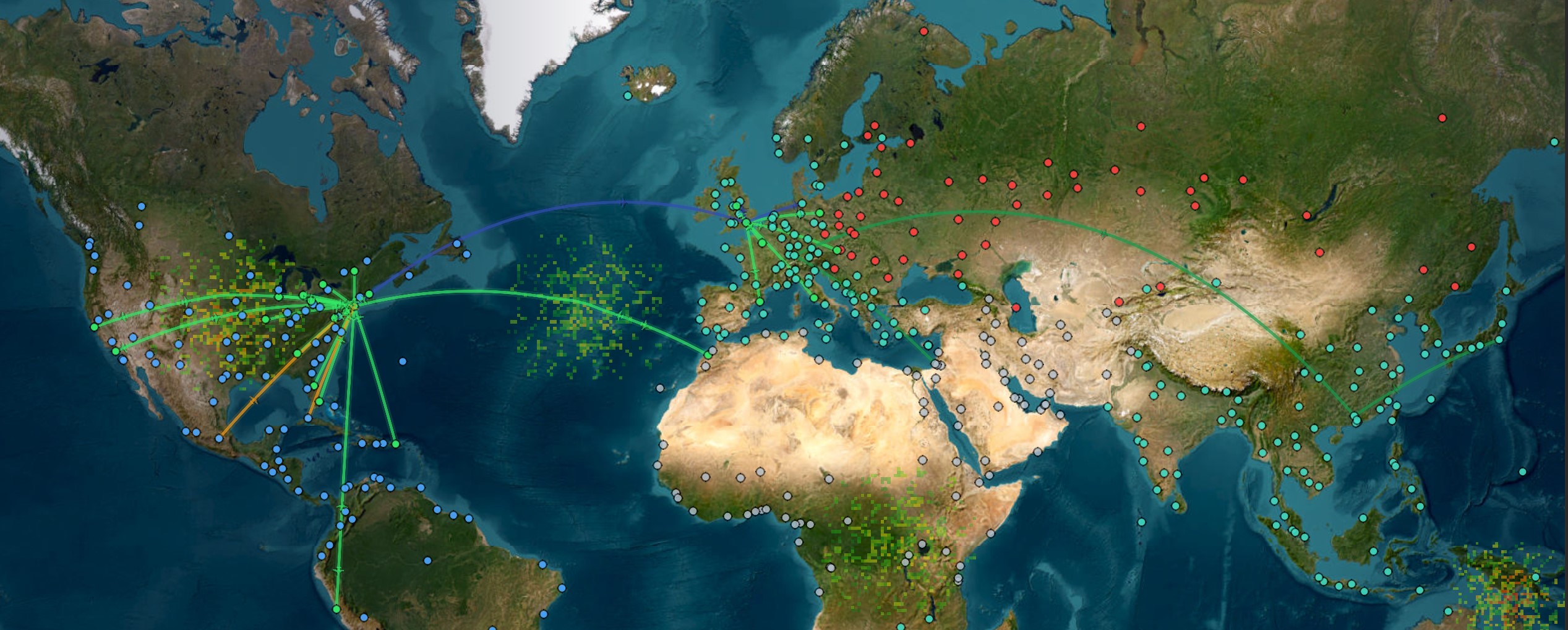 496 cities. 122,000+ possible routes. The Strategic Advisor handles it so you don’t have to.
Welcome to the War Room
SkyChart was always a strategy game. But now it has the instruments to match.
Twelve new analytical dashboards landed in the executive suite. Fleet Risk Report spots aging aircraft before they become paperweights. Cash Flow Forecast projects your bank balance 12 months out with scenario sliders. City Pair Saturation Finder ranks all 122,000+ city pairs by opportunity score so you stop flying into knife fights. Competitor Threat Assessment profiles every rival’s expansion strategy and overlap with your network.
Then we armed you.
Full economic warfare arrived in v0.2.28 and it changed the feel of the game entirely. Regional economies now boom and bust monthly. Cities enter multi-quarter gold rushes (+40% demand) or oversaturation busts (-30%). Dynamic market shocks hit quarterly — fuel crises, hub collapses, global recessions, airline mega-mergers.
Hub specialization lets you declare hubs as Cargo, Tourist, or Business for +20% matching demand. Pricing wars trigger automatically when you undercut a rival on contested routes — 1.5x costs, +20% demand, pure adrenaline. Dominate 40%+ of a region and AI rivals launch 6-month predatory market wars, undercutting everything and poaching your best cities.
Sealed-bid slot auctions replaced first-come-first-served. Code-share alliances with real revenue sharing. Corporate espionage — hire informants for three tiers of intel, from route data to full financials to outright corporate theft. Rivals spy back. Casey’s code name is “Tropical Thunder” and he refuses to change it.
The quarterly earnings call just became a battlefield briefing.
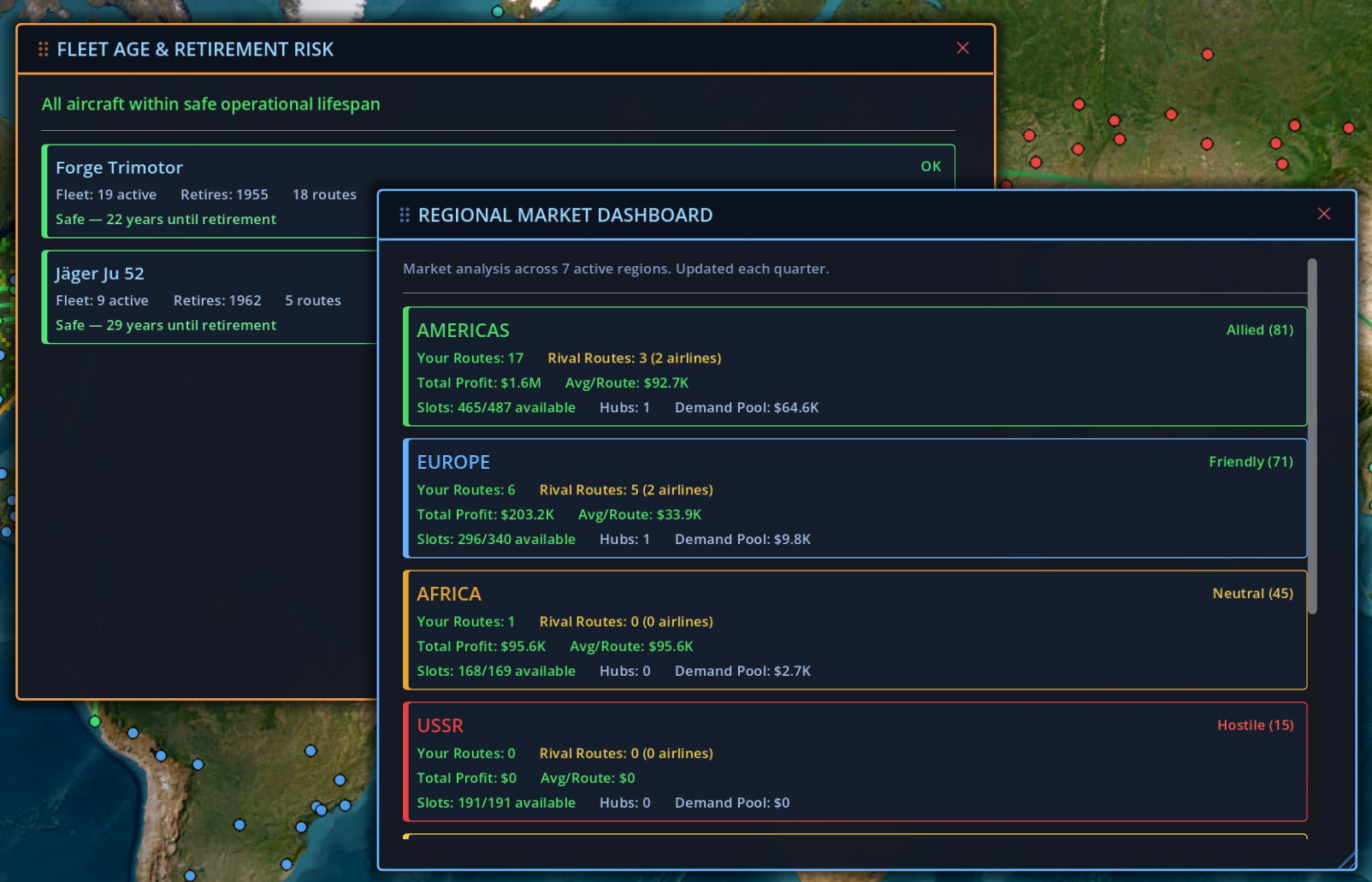 Twelve new dashboards. Bloomberg terminal energy for your airline empire.
A Cockpit Everyone Can Fly
Blog #1 mentioned controller support as a late addition. It’s now a flagship feature.
Full Steam Input API integration means every Xbox, PlayStation, Switch, and Steam Deck controller is automatically supported with correct button glyphs — not generic placeholders, but the exact icons for your controller. Three context-sensitive action sets switch seamlessly as you navigate. An on-screen QWERTY keyboard auto-appears for controller users when you focus any text field. Every single panel responds to gamepad input.
98 Steam Achievements are fully wired, from First Flight to Every Seat, Every City. 15 Steam Stats sync to your profile. Steam Timeline bookmarks your greatest moments for Steam Replay. Global and Local leaderboards let you compare your empire against the world.
But the update we’re most proud of is accessibility.
Five colorblind display modes — Normal, Deuteranopia, Protanopia, Tritanopia, and Achromatopsia. Three contrast levels. A text size slider from 80% to 150%. Screen reader support via text-to-speech. A Reduce Motion toggle that freezes the news ticker and skips floating animations.
And here’s the number: 866 hardcoded Color() calls replaced. Every UI panel in the entire game — fleet management, route performance, strategic intel, acquisitions, alliances, settings, difficulty select, era select, win condition, music player, leaderboard, everything — now routes its colors through a centralized AccessibilityPalette. Colorblind modes and contrast settings work everywhere, on every panel, in real time. No restart required.
Casey tested all five colorblind modes and discovered he’s been reading the fuel gauge wrong for years.
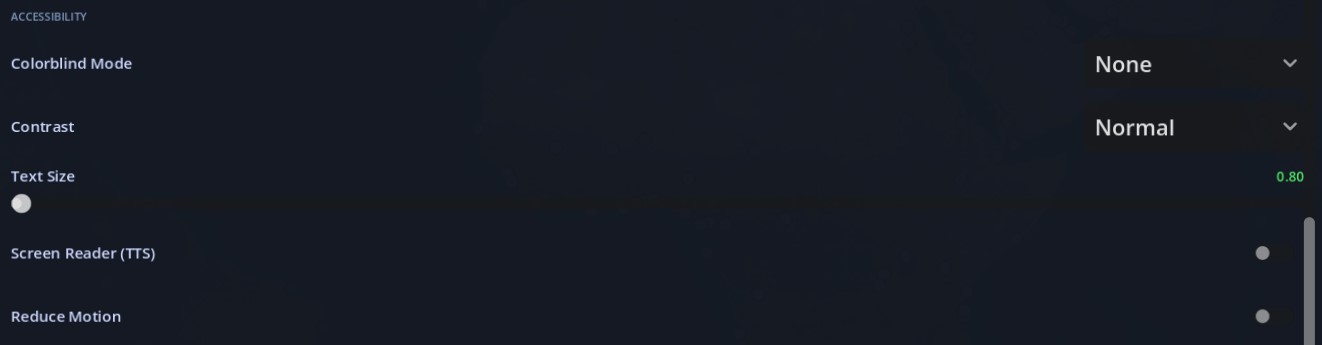 Five colorblind modes, three contrast levels, and 866 rewritten color calls. The cockpit is for everyone now.
Own It or Rent It
Back at v0.2.17, we shipped a system that quietly changed how the game plays: aircraft leasing.
Short on cash but need to open a route? Lease a plane — 1-year, 3-year, or 5-year terms. Shorter terms cost more per month but give you flexibility. Leases expire and auto-suspend the route until you renew, buy out, or walk away. AI rivals lease too, just like real budget carriers.
Alongside leasing came a proper aircraft hangar — owned planes now persist when removed from routes instead of vanishing into thin air. Store them, reuse them, or sell at depreciated market value. Aircraft refurbishment lets you extend a profitable plane’s service life by 10 years for 30% of its price.
We also shipped era progression — higher eras are locked until you complete the previous one. Master the Dawn of Flight before taking on the Jet Age. Beat any era in Passengers mode and you unlock Cargo. Beat Cargo, unlock Combined. Complete your first era and Sandbox Mode opens up — no bankruptcy, no time pressure, just build.
Black Box, Spotify, and the Kitchen Sink
A rapid-fire round of everything else that makes the game better:
Epic Games Store support. A new PlatformManager abstraction routes achievements, stats, leaderboards, and cloud saves to whichever storefront you’re flying out of. One codebase, multiple terminals.
The Black Box Recorder. A migration manager now runs before Steam connects, reconstructing company values from your save files and cleaning up bad leaderboard data. Every save stamps the game version. Career stats permanently log every era completion. Lifetime counters track hubs built, investments made, acquisitions closed, alliances formed, and trade wars weathered.
Spotify auto-connects on launch. If you’ve already authenticated, the Music Player picks up where you left off — no more re-swiping your boarding pass every session.
Save slots expanded from 5 to 10 with color-coded pill tags (difficulty, game mode, sandbox) and real timestamps. The HUD got reorganized — Routes & Fleet, Company, and a new Rivals dropdown with labeled section headers. Toast notifications now cascade vertically instead of stacking invisibly on top of each other. And 14 new keyboard shortcuts cover every strategic panel.
Even the small details got attention: Carbon Offset investments are now era-locked to 2005 (nobody was offsetting carbon in the propeller age), cargo mode shows tons and rates instead of “passengers,” and the quit dialog now offers to autosave before you leave.
Cleared for Approach
We’re at v0.2.32.10 now. The game that was “complete and very playable” at v0.2.17 has become something significantly larger — a 496-city, 66-aircraft, controller-native, accessibility-first airline empire sim with economic warfare, corporate espionage, and a performance engine that handles it all at 60 FPS.
Here’s what’s on the runway:
- Sound design — UI effects, ambient airport soundscapes, the satisfying click of every button
- Tutorial — a guided first-flight experience so new players don’t have to learn by going bankrupt
- Steam store page — achievements, cloud saves, and the final push to release
We’re still building SkyChart with the same philosophy: management sims deserve the same polish that action games get. Every tooltip, every animation, every accessibility option exists because we asked ourselves what would make us not want to alt-tab.
Thanks for following the journey. Keep your tray tables up and your route networks profitable.
— The Casey Jones Labs crew
Casey says he wants a raise and a corner office. He already got his name on the splash screen — and won’t let us forget it. He’s getting more walnuts.
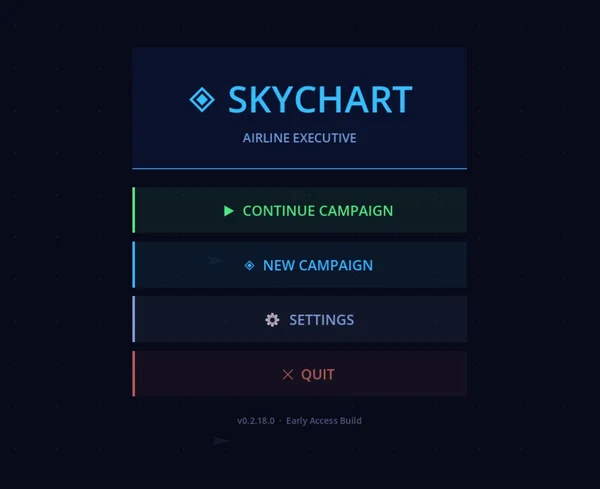 SkyChart: Airline Executive — coming to Steam for Windows, macOS, and Linux. Built with Godot 4.