Building SkyChart: How a Love Letter to Aerobiz Became a Full-Blown Airline Sim
Table of Contents
There’s a game from 1992 that ruined us. Aerobiz Supersonic on the SNES had no business being as addictive as it was — buying airport slots in Lagos, dodging oil crises, watching your little plane sprites crawl across a pixelated globe while you plotted world domination one hub at a time.
Nobody’s made a proper successor. So we decided to build one.
SkyChart: Airline Executive is our answer — a retro-modern airline management sim built in Godot 4, spanning 90 years of aviation history from the golden age of flying boats to the A380 era. And today, we’re pulling back the curtain on how it all came together.
The Pitch: “What If Aerobiz Had Modern UI?”
The core fantasy is simple: you’re the CEO of a fledgling airline, competing against AI rivals across four historical eras (1930–2020). You pick routes, buy planes, invest in cities, manage diplomacy with world regions, and try not to go bankrupt when OPEC decides to ruin everyone’s quarter.
But where Aerobiz gave you menus and text, we wanted a living world map — great circle flight paths, weather radar, day/night cycles, city boom animations, and aircraft sprites that bank into turns. The kind of thing that makes you lean back in your chair and think, “Yeah, I built this network.”
The vibe we landed on: high-tech retro. Neon glow lines on a dark map. Hex-shaped HUD buttons. A news ticker that could’ve come from a Bloomberg terminal in the ’90s. Modern UX wrapped in that unmistakable SNES-era charm.
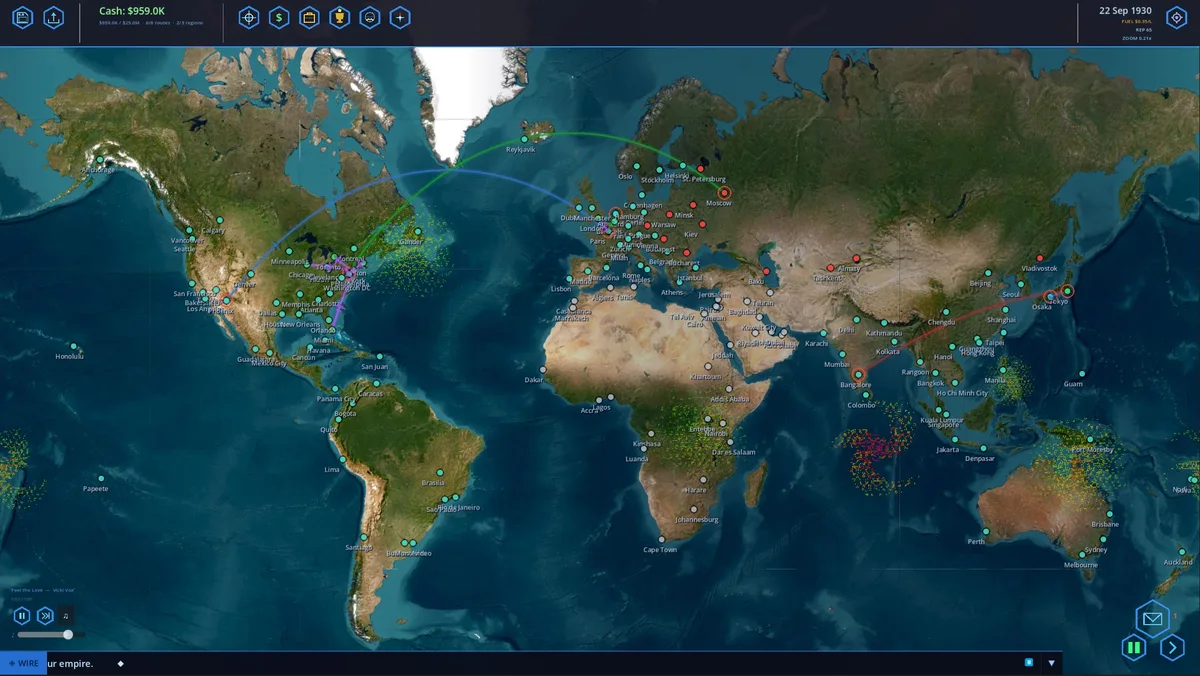 The global view: your airline network at a glance. Every glowing line is a route. Every moving dot is revenue.
150 Cities, 33 Aircraft, 90 Years of History
Let’s talk scale. SkyChart features:
- 150 cities across 7 world regions (plus post-1991 Russia), each with real population data, economic profiles, and seasonal demand curves. Tokyo surges in cherry blossom season. Miami booms in winter. Kolkata peaks during Durga Puja.
- 33 historically accurate aircraft from the Douglas DC-3 (1936) to the Boeing 787 Dreamliner. Each has authentic range, speed, capacity, operating costs, and a retirement year — fly a DC-3 into the jet age and watch your maintenance costs eat you alive.
- 60+ historical events that reshape the playing field. The Great Depression tanks demand. WWII bombs London and Berlin (literally — you’ll need to rebuild those airports). The 1973 oil crisis doubles your fuel costs overnight. COVID-19 shows up in Era 4 and, well… you remember.
- 4 playable eras, each with escalating goals. Era 1 asks you to survive with propeller planes and $5M. Era 4 wants a $2 billion empire spanning all seven regions.
Every era feels like a different game. The strategic calculus of a 1930s flying boat network is nothing like the cutthroat hub-and-spoke warfare of the 1990s.
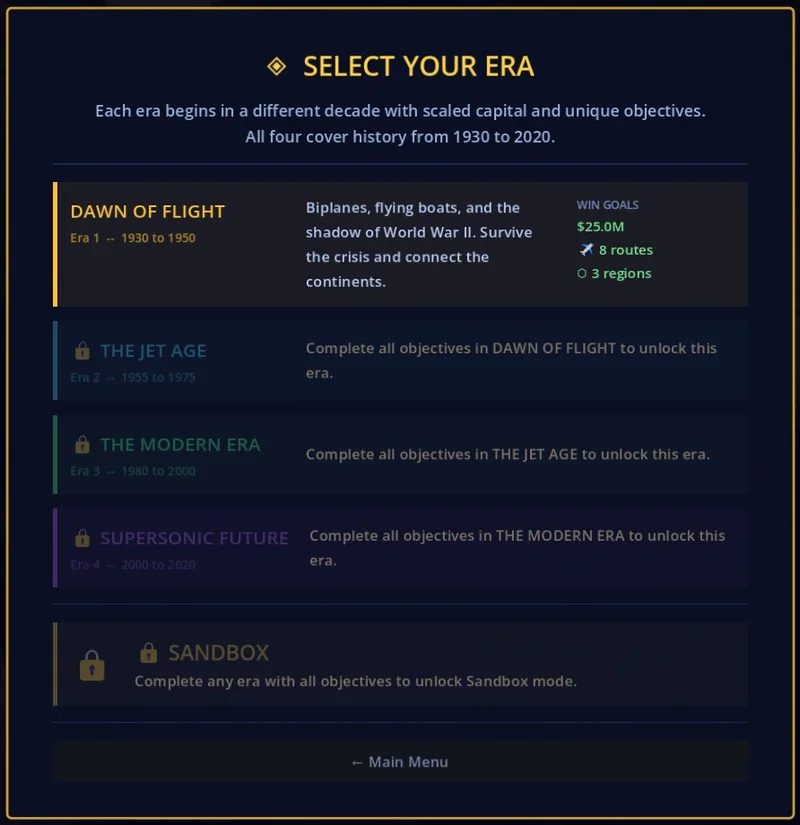 Pick your era: each one is a different game with different aircraft, events, and victory conditions.
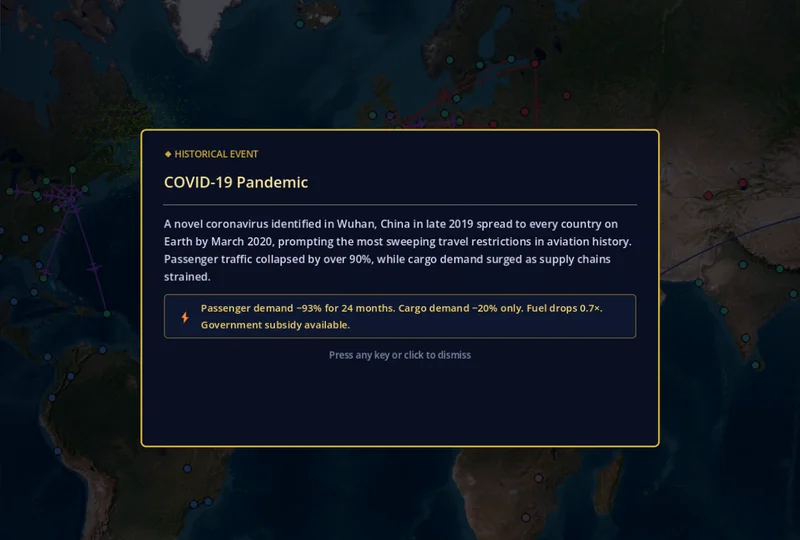 History doesn’t repeat, but it does spike your fuel costs.
The AI That Actually Plays Back
One thing we refused to ship with was brain-dead AI. SkyChart’s rival airlines don’t just randomly expand — they have home regions, weighted route selection based on population and economic data, quarterly pricing adjustments, fleet upgrades when aircraft retire, and hub investment strategies.
They undercut your prices on contested routes. They buy up airport slots in cities you’ve been eyeing. They even lease aircraft when they’re short on cash, just like a real budget carrier would.
And in Era 4, if you’ve built an empire they can’t compete with? They might just become an acquisition target. One hostile takeover per era. Their routes, slots, and hubs — all yours. For a price.
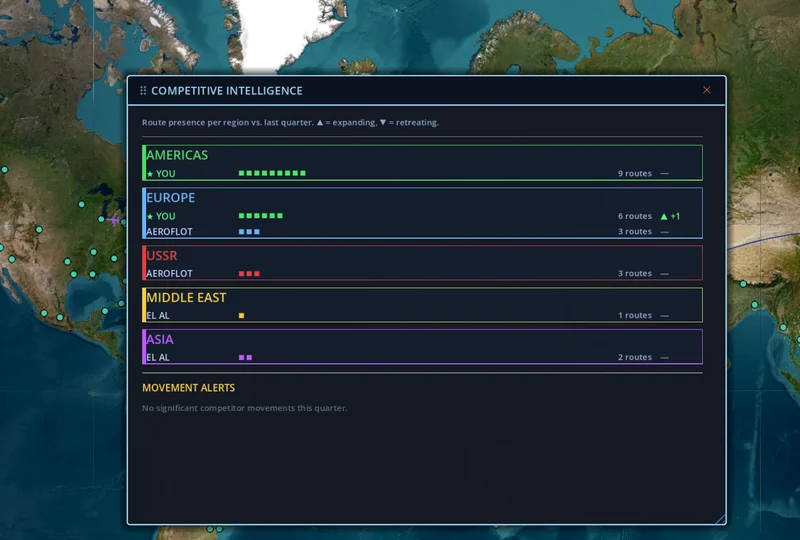 Know thy enemy: the Intel panel tracks every rival’s moves across all seven regions.
The Cockpit: UI That Doesn’t Fight You
If you’ve ever played a management sim where the UI was the real boss fight, you know the pain. We’ve spent an unreasonable amount of time making sure SkyChart’s interface is something you want to use.
Every panel is a draggable, resizable window — Route Manager, Fleet Overview, Strategic Advisor, City Intelligence, Competitive Intel, Music Player. Drag them where you want. Resize them. The game remembers your layout between sessions.
The Strategic Advisor is your AI co-pilot. It scans every possible city pair in the world (that’s 11,175 combinations), ranks them by projected profit, and serves up the best opportunities on a silver tray. It runs on a background thread pool — up to 8 worker threads — so it never freezes the game, even when crunching thousands of routes.
Full controller support was a late addition that became a passion project. Xbox, PlayStation, and Switch controllers all work natively. A virtual cursor lets you select cities on the map with the right stick. A radial menu (hold LB) gives you instant access to every panel. Every window responds to B-to-close. We even built a graphical Controls Guide with keycap and button-glyph widgets.
Oh, and there’s a built-in music player. Three sources: the game’s era-appropriate soundtrack (44 tracks spanning jazz age to modern electronic), your local music library, or Spotify integration via OAuth. Because what’s running an airline without a good playlist?
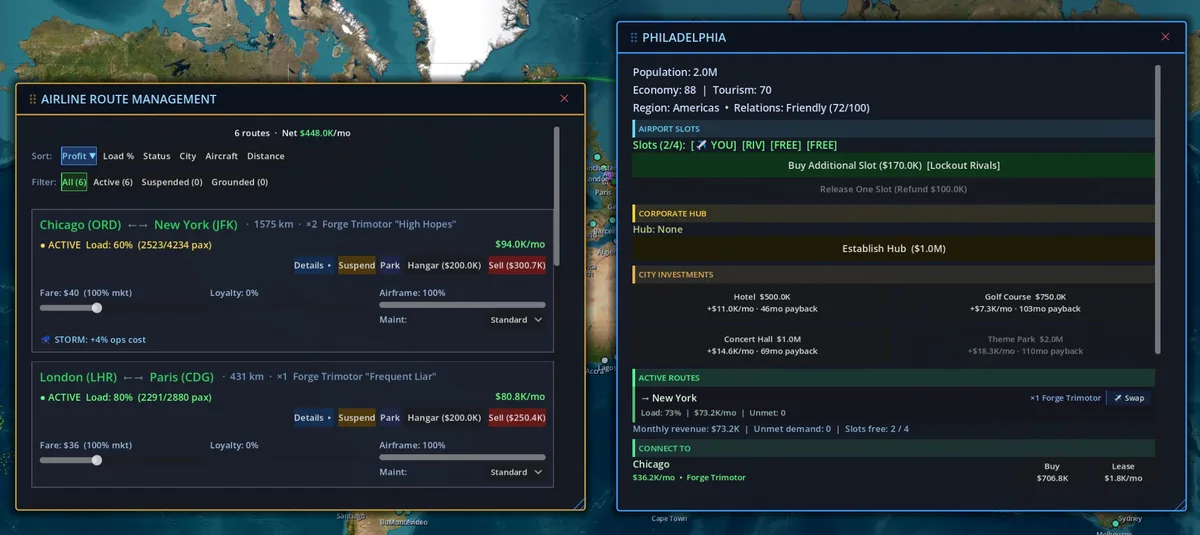 Your cockpit, your layout. Every panel is draggable, resizable, and remembers where you left it.
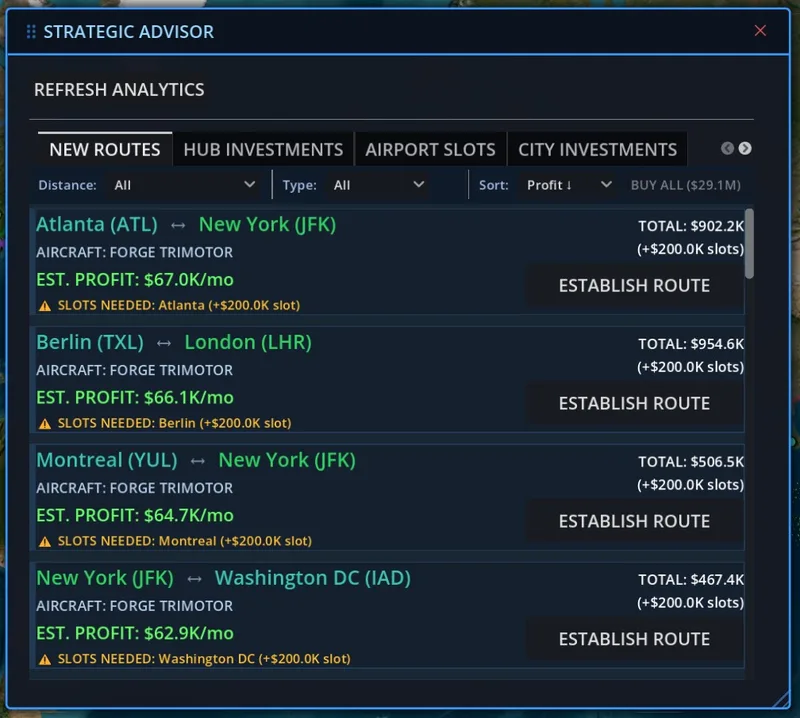 The Strategic Advisor crunches 11,175 city pairs so you don’t have to.
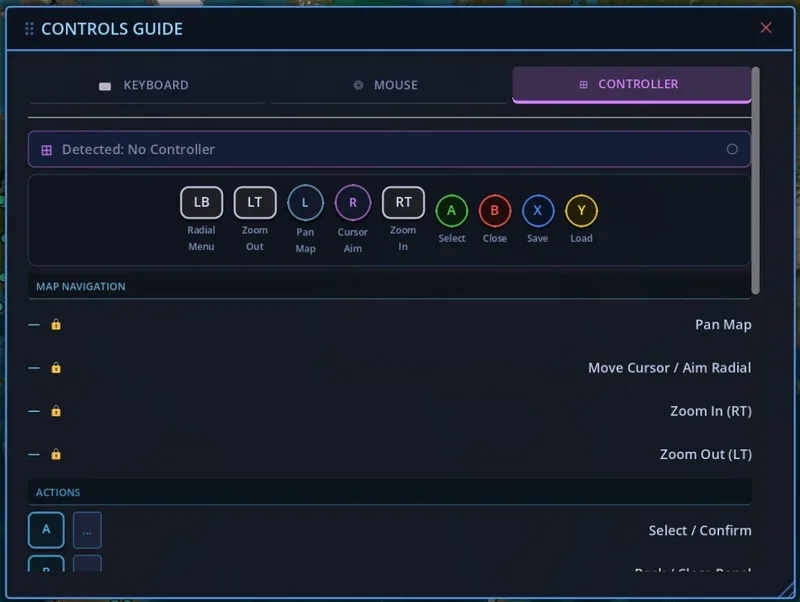 Full controller support: every button mapped for couch-friendly airline management.
Under the Hood: A GDScript Love Story
SkyChart is built entirely in Godot 4 with GDScript 2.0 — no C#, no C++ modules. Everything from the route economics engine to the tile map renderer is pure GDScript.
Some highlights from the engineering side:
Threading everywhere. Monthly economic calculations, route recommendations, and AI expansion all run on worker threads. The game stays silky smooth even when processing 2,000+ routes across four rival airlines.
A real window manager. WindowManager is an autoload singleton that handles focus-to-front layering (click a window, it comes to top), position/size persistence to disk, and screen-adaptive sizing. Three tiers: Normal (gameplay panels), Modal (settings, save/load), and HUD (always on top).
OSM-style map tiles. Zoom into any region and high-detail map tiles load dynamically — sprite pooling, LRU texture cache, disk caching, and online fetch. Three styles: Retro Dark (default), Satellite, and Clean Vector.
Great circle paths with weather avoidance. Flight paths follow spherical interpolation for geographic accuracy, and dynamically route around storm systems on the map. Aircraft sprites bank into turns and cast drop shadows. It’s a lot of math for cosmetics, but it makes the world feel real.
Great circle routing in action: planes follow realistic curved paths and dodge weather systems.
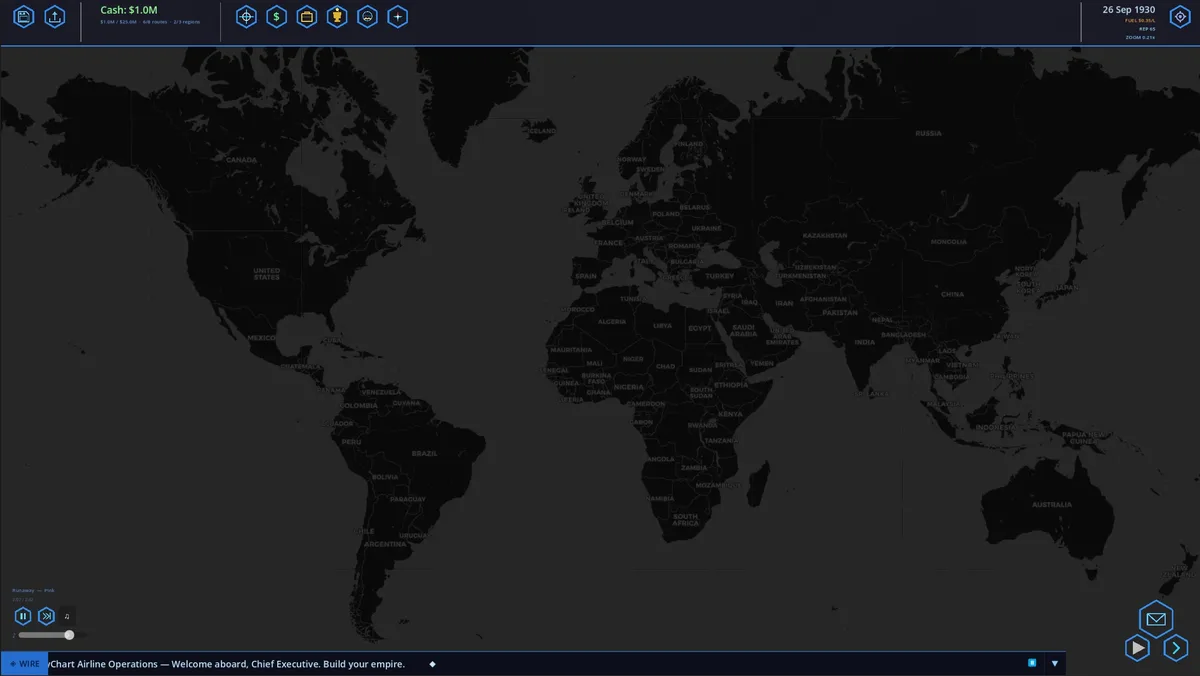 Zoom in and OSM-style tiles load on the fly — three map styles to choose from.
The Numbers Game: Route Economics
At the heart of SkyChart is an economic model we’re genuinely proud of. Every route calculates monthly profit through a pipeline that considers:
- Base demand (city population x economic multiplier)
- Seasonal variation (12 monthly multipliers per city)
- Investment bonuses (hotels, golf courses, concert halls, theme parks)
- Regional diplomacy (better relations = more demand)
- Event modifiers (wars, oil crises, pandemics)
- Reputation (safety record and customer service affect demand globally)
- Competition (demand splits by attraction score — pricing, loyalty, hub presence)
- Aircraft age (planes past retirement year cost +40% to operate and lose 15% demand)
- Fuel prices (OPEC events can double your variable costs overnight)
The result is a system where no two routes play the same way, and the optimal network in 1935 looks nothing like the optimal network in 2005.
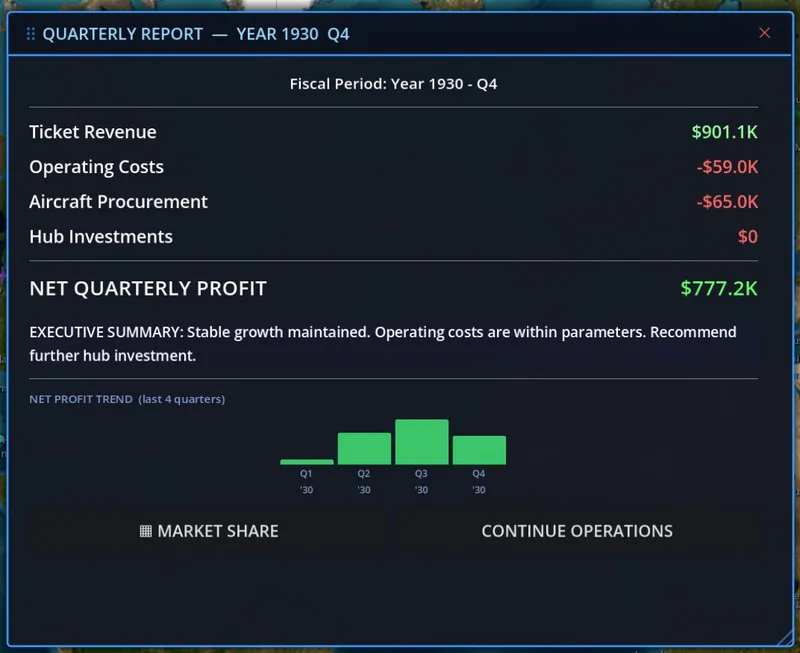 Every quarter, the numbers tell the story. That dip in Q3? OPEC happened.
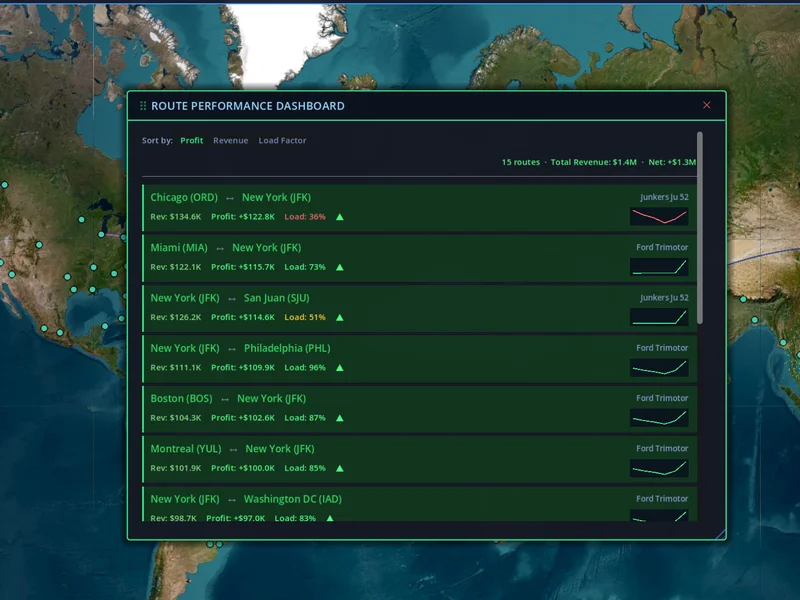 Route Performance: every route ranked by profit with trend sparklines. Green is good. Red means it’s time to make hard decisions.
What’s Next
We’re currently at v0.2.17 — which in SkyChart versioning means we’re deep into Phase 16+ polish. The core game is complete and very playable. Here’s what’s on the runway:
- UI Sound Effects & Ambient Soundscape — button clicks, panel whooshes, airport ambience
- First-Run Tutorial — a 12-chapter guided walkthrough so new players don’t need to learn by crashing (financially, not literally… though also literally)
- Steam Release Prep — store page, achievements integration, cloud saves
We’ve been building SkyChart with the philosophy that management sims deserve the same UI love that action games get. Every tooltip, every animation, every quality-of-life feature exists because we asked: “What would make us not want to alt-tab?”
Follow the Journey
SkyChart is being developed by Casey Jones Labs — a small studio with a big love for the games that shaped us. If you grew up debating whether to open a route to Anchorage or invest in a theme park in Honolulu, this game is for you.
Stay tuned for more dev blogs, and keep your tray tables in the upright position.
— The Casey Jones Labs crew
 SkyChart: Airline Executive — coming to Steam for Windows, macOS, and Linux. Built with Godot 4.